AWS Announces Cross-Account Capabilities for Amazon EBS Volume Clones to Enhance Data Mobility and Security

Amazon Web Services (AWS) has significantly expanded the utility of its storage infrastructure by introducing cross-account support for Amazon Elastic Block Store (EBS) Volume Clones. This development, which builds upon the foundation of point-in-time cloning technology launched by the cloud giant last year, represents a strategic shift in how enterprise-level data is managed, shared, and protected across complex, multi-account AWS environments. By enabling the seamless transfer of data volumes between distinct accounts, AWS is addressing a long-standing requirement for DevOps teams, security administrators, and database architects who manage decentralized cloud architectures.
The Evolution of EBS Storage Management
To understand the significance of this announcement, one must look back at the trajectory of AWS storage services. For years, the standard method for duplicating block storage was the creation of snapshots, which involve a multi-step process of capturing data, storing it in Amazon S3, and then re-hydrating that data into a new volume. This process, while reliable, is often time-consuming and resource-intensive, particularly for large-scale datasets.
In 2025, AWS introduced "Volume Clones," a feature designed to provide instantaneous, point-in-time copies of EBS volumes. By allowing these clones to exist within the same Availability Zone (AZ) without the overhead of traditional snapshots, AWS provided a performance boost for tasks such as data replication and temporary environment instantiation. The introduction of cross-account functionality today serves as the natural progression of this technology, moving the capability from a local optimization tool to a cross-organizational enterprise resource.
How the Mechanism Operates
The technical implementation of this new feature relies heavily on the integration of AWS Resource Access Manager (RAM). AWS RAM acts as the broker for this resource-sharing capability, allowing organizations to securely share AWS resources across their accounts or within an AWS Organization without the need for complex, manual replication scripts or insecure data movement patterns.
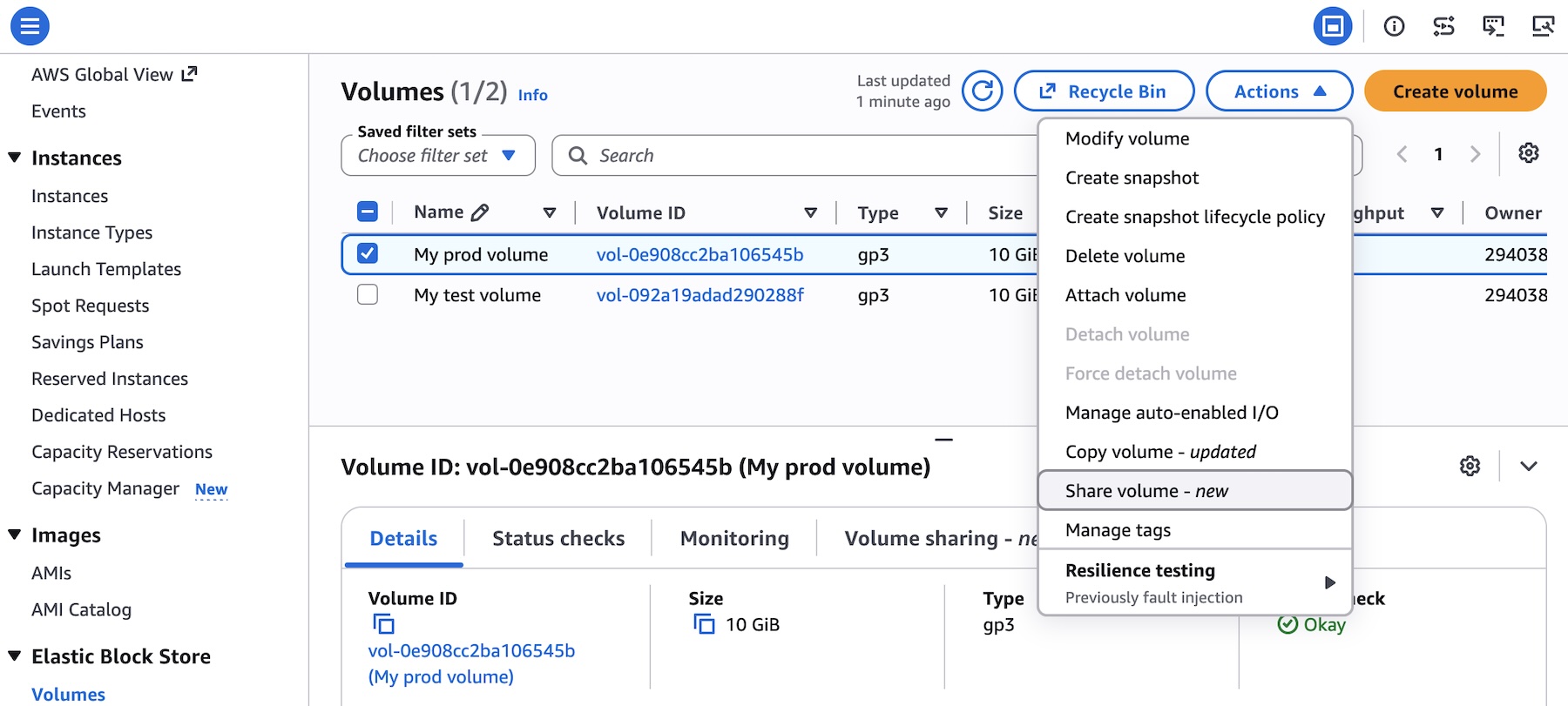
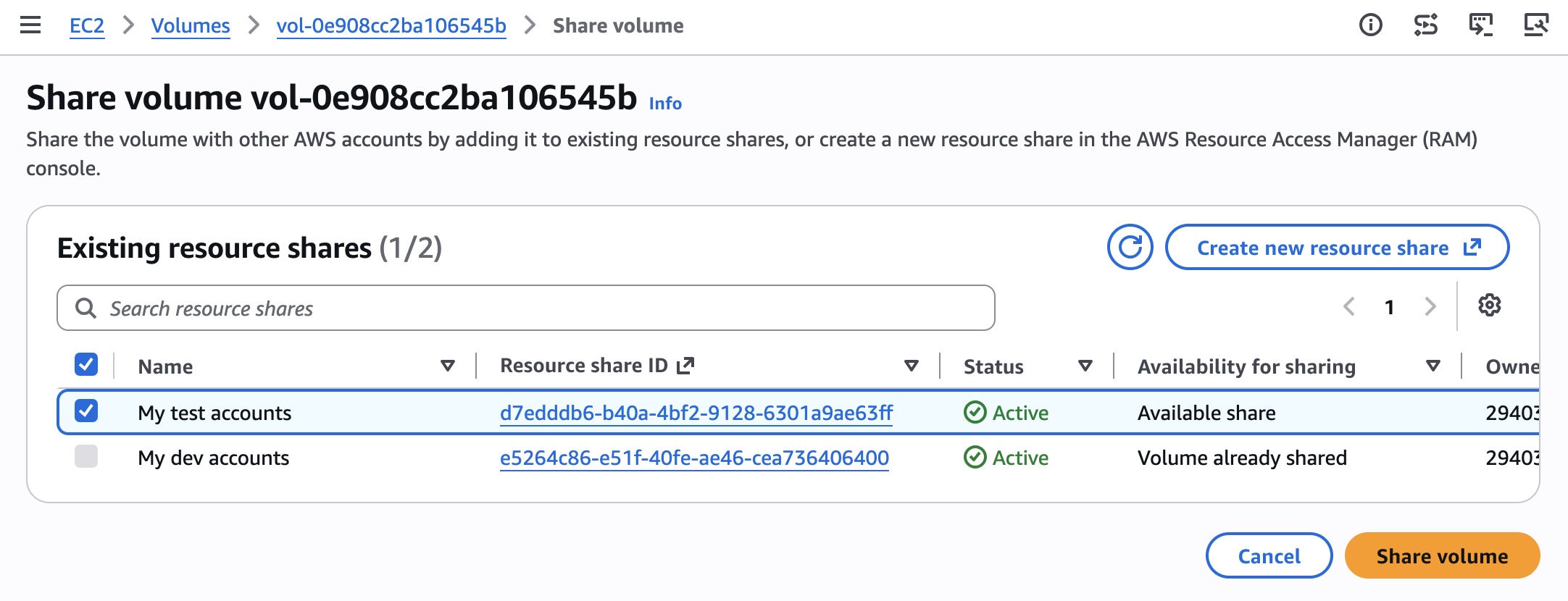
The workflow begins in the source AWS account, where the volume owner identifies the specific EBS volume to be cloned. Using the Amazon EBS console, the administrator initiates the "Share volume" command. This action triggers a resource share request via AWS RAM. The administrator can then specify which target accounts—or specific organizational units (OUs)—are authorized to access this volume. Once the request is sent, the target account holder receives a notification through the RAM console.

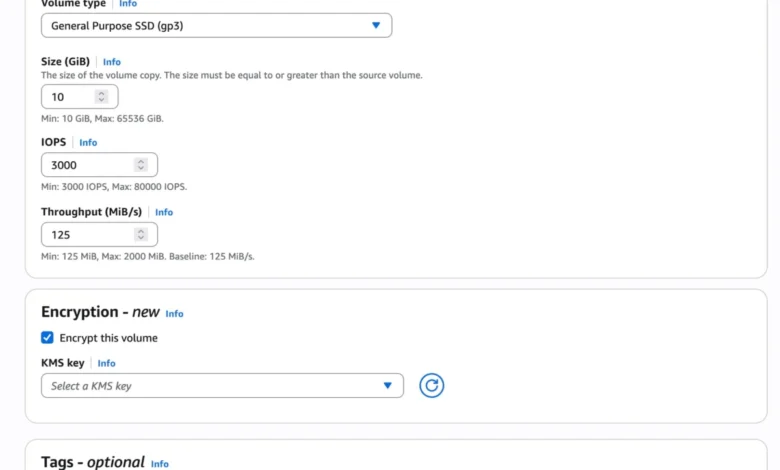
Upon accepting the resource share, the target account gains the ability to create a copy of the shared volume. A critical component of this workflow is the option to apply new encryption settings. As data traverses the boundary between accounts, the target user can elect to re-encrypt the volume using an AWS Key Management Service (KMS) key unique to the target account. This ensures that even if the source account has specific security policies, the target environment can maintain its own compliance posture and encryption standards, mitigating the risk of unauthorized data exposure.
Strategic Implications for Enterprise DevOps
The ability to move data volumes across accounts has profound implications for the software development lifecycle (SDLC). In modern cloud-native architectures, it is standard practice to isolate production, staging, and development environments into separate AWS accounts to ensure security, cost allocation, and blast-radius containment.
Historically, "refreshing" a test environment with production-grade data—a necessity for accurate bug reproduction and performance testing—was a bottleneck. It required data pipelines that often took hours or days to synchronize. With cross-account volume cloning, this process is reduced to a matter of minutes. By leveraging instantaneous clones, organizations can now:
- Accelerate Testing Cycles: Developers can pull production data into sandboxed accounts for immediate analysis without impacting the performance of the production environment.
- Enhance Security Auditing: Security teams can clone production volumes into an isolated "forensics" account to conduct deep-packet analysis or vulnerability scanning without risking the integrity of live systems.
- Simplify Disaster Recovery: While not a primary backup tool, the capability allows for rapid data movement to standby environments, providing a secondary layer of data accessibility during regional or account-level incidents.
Data Security and Compliance Considerations
From a compliance perspective, the integration with AWS KMS is the most critical feature. Under various regulatory frameworks such as GDPR, HIPAA, and PCI-DSS, data sovereignty and encryption at rest are non-negotiable. The new functionality ensures that while the data is technically "shared," the cryptographic keys governing that data remain under the strict control of the target account’s security policies.
Furthermore, the auditability of these actions is maintained through AWS CloudTrail. Every instance of an EBS volume being shared or cloned is logged, providing a clear trail of who authorized the access, which account received it, and when the copy was executed. This level of visibility is essential for enterprises operating in regulated sectors that require detailed reporting on data movement and access control.
Industry Context and Future Outlook
This update arrives at a time when the "Multi-Account Strategy" is becoming the gold standard for AWS customers. As organizations scale, the "one account for everything" approach has become obsolete due to limits on service quotas and the complexities of IAM policy management. AWS has responded by making the inter-account ecosystem more fluid.
Industry analysts observe that this move also positions AWS to better compete with hybrid-cloud storage providers. By reducing the friction involved in managing multi-account storage, AWS is essentially lowering the "switching cost" for internal teams to move from monolithic account structures to modular, micro-account architectures.
For developers and systems administrators, the inclusion of support for the AWS MCP (Model Context Protocol) Server and associated plugins is particularly notable. By enabling programmatic control over volume sharing and cloning via AI-assisted coding tools, AWS is signaling a shift toward infrastructure-as-code (IaC) being the primary interface for storage management. This allows teams to automate the creation of testing environments directly through CI/CD pipelines, effectively turning infrastructure management into an automated software service.
Availability and Getting Started
Cross-account volume cloning is currently being rolled out across all AWS Regions that support the standard EBS Volume Clone feature. Users are encouraged to verify the specific availability in their home region via the AWS Capabilities by Region dashboard.

For those ready to integrate this into their workflows, the process is accessible through the Amazon EC2 console under the "Volumes" management tab. AWS has also updated the Amazon EBS User Guide to include detailed documentation on IAM permissions and RAM share configurations. Feedback mechanisms remain open via AWS re:Post, the community-driven technical support platform, ensuring that as the feature matures, the engineering teams at AWS can iterate based on real-world use cases.
As enterprises continue to decentralize their cloud operations, tools that bridge the gap between isolated accounts—while maintaining strict security boundaries—will remain the backbone of efficient cloud management. The introduction of cross-account EBS volume cloning is a significant, yet measured, step in that ongoing evolution.
Related posts: